

Indonesia's Potential
COMMUNITY LITERACY AND FINANCIAL INCLUSION INDEX INCREASED
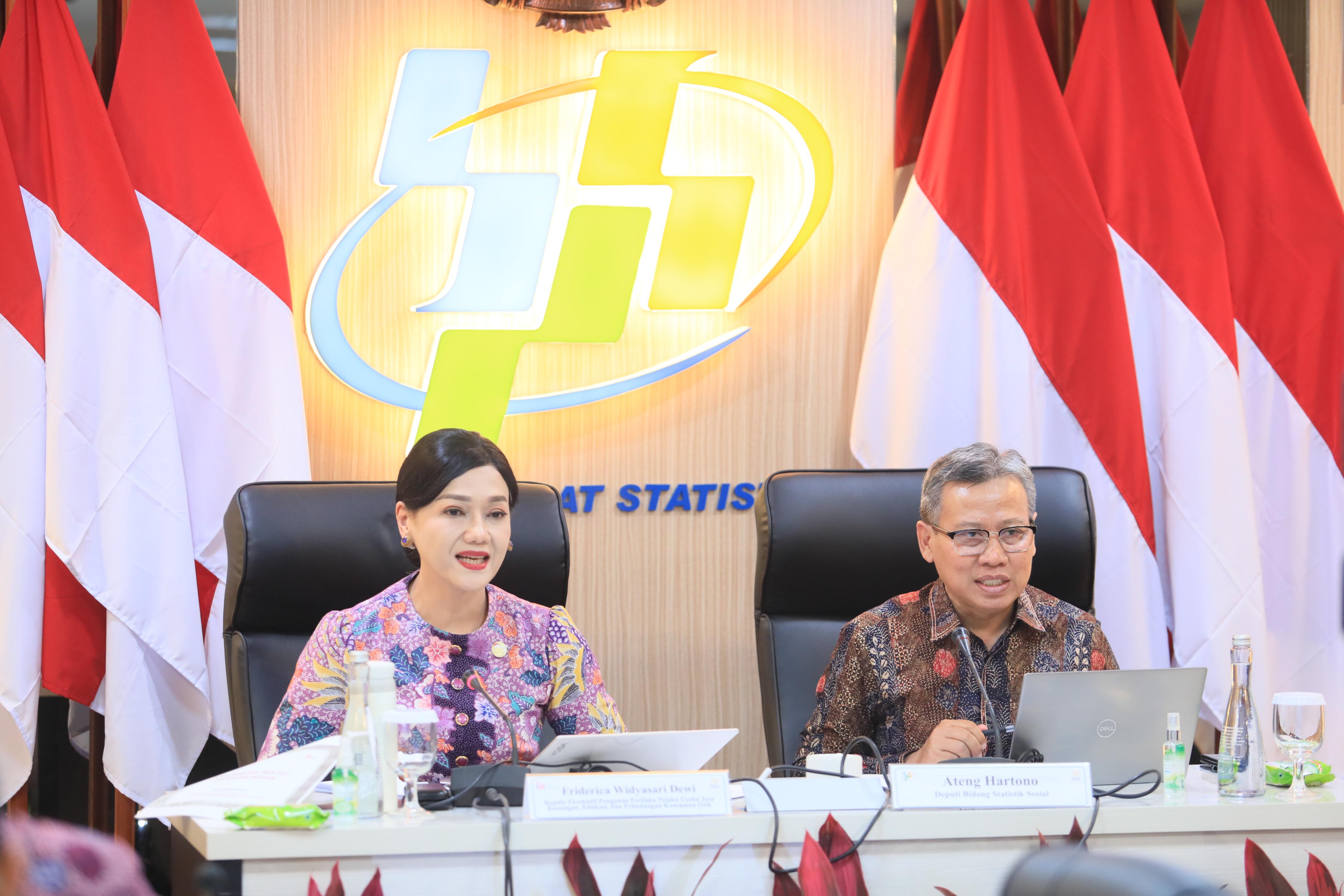
The Financial Services Authority (OJK) and Statistics Indonesia (BPS) announced the results of the 2025 National Survey on Financial Literacy and Inclusion (SNLIK). Jakarta, May 2, 2025. The Financial Services Authority (OJK) and the Central Statistics Agency (BPS) announced the results of the 2025 National Survey on Financial Literacy and Inclusion (SNLIK), which showed an increase in the financial literacy index reaching 66.46 percent and the financial inclusion index reaching 80.51 percent. The 2025 SNLIK results are an increase compared to the 2024 SNLIK, which showed a financial literacy index of 65.43 percent and a financial inclusion index of 75.02 percent. The announcement of the 2025 SNLIK results was delivered by the Chief Executive of the Financial Services Business Conduct Supervisory Agency, Education and Consumer Protection of the Financial Services Authority (OJK), Friderica Widyasari Dewi and the Deputy for Social Statistics of the BPS, Ateng Hartono at the Central Statistics Agency Office, Jakarta, Friday. The Financial Services Authority (OJK) and the Central Statistics Agency (BPS) are once again conducting the National Survey of Financial Literacy and Inclusion (SNLIK) to measure the financial literacy and inclusion index of the Indonesian public as a basis for future programs to improve financial literacy and inclusion. The 2025 SNLIK is the second collaboration between the Central Statistics Agency (BPS) and the Financial Services Authority (OJK), following the 2024 SNLIK. The collaboration aims to obtain a picture of Indonesia's financial literacy and inclusion situation from two perspectives: by considering the evaluation of the previous SNLIK implementation and the government's need for more comprehensive data through the National Council for Financial Inclusion (DNKI). The 2025 SNLIK calculation will be conducted using two methods. The first method, known as the Sustainability Method, is a calculation method that covers nine financial services sectors (Banking, Capital Markets, Insurance, Financing Institutions, Pension Funds, Pawnshops, Microfinance Institutions, Fintech Lending (Pindar), PT Permodalan Nasional Madani) and Payment System Providers (PSP) as covered in the 2024 SNLIK. Therefore, it can be used as a measuring tool for the success of the OJK's financial literacy and inclusion program. Meanwhile, the second method, referred to as the DNKI Coverage Method, is a calculation method that expands the scope of the financial sector by adding the Social Security Administration Agency (BPJS) for Health, BPJS for Employment, and other Financial Services Institutions (Savings and Loan Cooperatives (KSP)/Crypto Asset Trading Organizers/PT Pos Indonesia/Guarantee Institutions/etc.). The Sustainability method shows Indonesia's financial literacy index at 66.46 percent and its financial inclusion index at 80.51 percent. Meanwhile, the DNKI Coverage method shows a financial literacy index of 66.64 percent and a financial inclusion index of 92.74 percent. Furthermore, using both the Sustainability and DNKI Coverage methods, sharia financial literacy reached 43.42 percent and sharia financial inclusion at 13.41 percent. The 2025 SNLIK sample household census was conducted from January 22 to February 11, 2025, in 34 provinces, covering 120 cities/regencies, including eight OJK office areas (1,080 census blocks). The 2025 SNLIK respondents totaled 10,800 people aged 15 to 79. The sampling method used is stratified multistage cluster sampling : The selection of districts/cities uses PPS (Probability Proportional to Size)–Systematic Sampling with the size being the number of families, where the districts/cities in the OJK office area are automatically selected as samples. The selection of a number of census blocks in each selected district/city uses PPS–Systematic Sampling with a size of the number of families taking into account the representation of urban/rural areas. The selection of ten eligible households in each census block from the updated results using Systematic Sampling with implicit stratification based on the education level of the head of the household. The selection of one eligible respondent aged 15-79 years in the sample household used random sampling with implicit stratification based on the age of eligible household members using the Kish Table. The 2025 SNLIK uses financial literacy parameters consisting of knowledge, skills, beliefs, attitudes, and behavior, while the financial inclusion index uses usage parameters for financial products and services. Sustainability Method Based on village classification, the financial literacy and inclusion indexes in urban areas were 70.89 percent and 83.61 percent, respectively, higher than those in rural areas, which were 59.60 percent and 75.70 percent, respectively. Based on gender, men's financial literacy is higher than women's, at 67.32 percent and 65.58 percent, respectively. Meanwhile, men's financial inclusion is comparable to women's, at 80.73 percent and 80.28 percent, respectively. Based on age, the 26-35, 18-25, and 36-50 age groups have the highest financial literacy indexes, at 74.04 percent, 73.22 percent, and 72.05 percent, respectively. Conversely, the 15-17 and 51-79 age groups have the lowest financial literacy indexes, at 51.68 percent and 54.55 percent, respectively. Furthermore, the 18-25, 26-35, and 36-50 age groups have the highest financial inclusion indexes, at 89.96 percent, respectively. 86.10 percent and 85.81 percent, respectively. Conversely, the 51-79 and 15-17 age groups had the lowest financial inclusion indexes, at 66.88 percent and 74.00 percent, respectively. Based on the highest level of education completed, the groups of university graduates, high school graduates/equivalent graduates and junior high school graduates/equivalent graduates have the highest financial literacy index, namely 90.63 percent, 79.18 percent and 64.04 percent respectively. In contrast, the education groups of no/never attended school/did not complete elementary school/equivalent and those who completed elementary school/equivalent had the lowest financial literacy index, at 43.20 percent and 54.50 percent, respectively. Furthermore, the groups with higher education, high school/equivalent, and junior high school/equivalent had the highest financial inclusion index, at 99.10 percent, 92.81 percent, and 82.00 percent, respectively. Furthermore, the groups with no/never attended school/did not complete elementary school/equivalent and those with completed elementary school/equivalent had the lowest financial inclusion indexes, at 56.95 percent and 68.06 percent, respectively. The data indicates that the higher the education level, the higher the financial literacy and inclusion indexes. Based on daily work/activities, the employee/professional, retiree/retired and entrepreneur/self-employed groups have the highest financial literacy index, namely 85.80 percent, 74.11 percent and 73.60 percent respectively. On the other hand, the unemployed/not yet employed, farmers/livestock breeders/planters/fishermen and other occupations have the lowest financial literacy index, namely 49.36 percent, 58.87 percent and 60.17 percent respectively. Furthermore, the retirees/retired, employees/professionals, and entrepreneurs/self-employed groups had the highest financial inclusion indexes, namely 100.00 percent, 95.11 percent, and 88.66 percent, respectively. Conversely, the unemployed/not yet working, farmers/livestock breeders/planters/fishermen, and other occupations had the lowest financial inclusion indexes, namely 64.82 percent, 69.40 percent, and 74.73 percent, respectively. DNKI Coverage Method Based on village classification, the financial literacy and inclusion indexes of urban areas were 71.00 percent and 94.48 percent, respectively, higher than those of rural areas at 59.87 percent and 90.03 percent, respectively. Based on gender, men's financial literacy index is higher than women's, at 67.53 percent and 65.73 percent, respectively . Meanwhile, men's financial inclusion index is comparable to women's, at 92.58 percent and 92.89 percent, respectively . Based on age, the 26-35, 18-25 and 36-50 age groups have the highest financial literacy index, at 74.05 percent, 73.26 percent and 72.12 percent, respectively . In contrast, the 15-17 and 51-79 age groups had the lowest financial literacy indexes, at 51.86 percent and 55.03 percent, respectively. Furthermore, the 18-25, 36-50, and 26-35 age groups had the highest financial inclusion indexes, at 95.07 percent, 94.11 percent, and 93.52 percent, respectively. Conversely, the 51-79 and 15-17 age groups had the lowest financial inclusion indexes, at 89.70 percent and 91.32 percent, respectively. Based on the highest level of education completed, the groups of university graduates, high school graduates/equivalent graduates and junior high school graduates/equivalent graduates have the highest financial literacy index, namely 90.63 percent, 79.19 percent and 64.37 percent respectively. On the other hand, the education groups of no/never attended school/did not complete elementary school/equivalent and completed elementary school/equivalent had the lowest financial literacy index, namely 43.77 percent and 54.62 percent respectively. Furthermore, the groups with higher education, high school graduates/equivalent, and junior high school graduates/equivalent have the highest financial inclusion index, namely 99.77 percent, 97.23 percent, and 92.74 percent, respectively . In contrast, the groups with no/never attended school/did not complete elementary school/equivalent and those with completed elementary school/equivalent had the lowest financial inclusion indexes, at 83.64 percent and 88.83 percent, respectively. The data indicates that the higher the level of education, the higher the financial literacy and inclusion. Based on daily work/activities, the employee/professional, retiree/retired and entrepreneur/self-employed groups have the highest financial literacy index, namely 85.80 percent, 74.11 percent and 73.96 percent respectively. On the other hand, the unemployed/not yet employed, farmers/livestock breeders/planters/fishermen and other occupations have the lowest financial literacy index, namely 49.46 percent, 59.32 percent and 60.31 percent respectively. Furthermore, the retirees/retired, employees/professionals, and entrepreneurs/self-employed groups had the highest financial inclusion indexes, namely 100.00 percent, 98.15 percent, and 95.21 percent, respectively. Conversely, the unemployed/not yet working, farmers/livestock breeders/planters/fishermen, and other occupations had the lowest financial inclusion indexes, namely 84.04 percent, 87.56 percent, and 92.29 percent, respectively. Based on the financial services sector, the financial literacy and inclusion index is still supported the highest by the banking sector, namely 65.50 percent and 70.65 percent. The 2025 SNLIK is a key factor for the OJK and other stakeholders in formulating policies and strategies, and designing financial products and services that meet consumer needs and capabilities in order to improve public welfare. The results of the 2025 SNLIK also show segments of society that have lower levels of financial literacy or inclusion compared to the national level, namely: Based on gender, namely female residents; Based on village classification, namely residents who live in rural areas; Based on age groups, namely the population aged 15-17 years and 51-79 years; Based on the highest level of education completed, namely residents with low education (graduated from junior high school/equivalent or below); Based on daily work/activities, namely farmers/livestock breeders/planters/fishermen, students/university students, housewives, not/not yet working and other workers (other than employees/professionals, entrepreneurs/self-employed and retirees/retired). Therefore, the Financial Services Authority (OJK) will intensify financial literacy and inclusion activities for this group. The OJK's focus on improving financial literacy and inclusion, both conventionally and in accordance with Sharia law, is outlined in the Roadmap for Supervision of Financial Services Business Actors' Behavior, Consumer Education, and Protection (2023-2027), the 2025-2029 National Medium-Term Development Plan (RPJMN), and the 2025-2045 National Long-Term Development Plan (RPJPN).